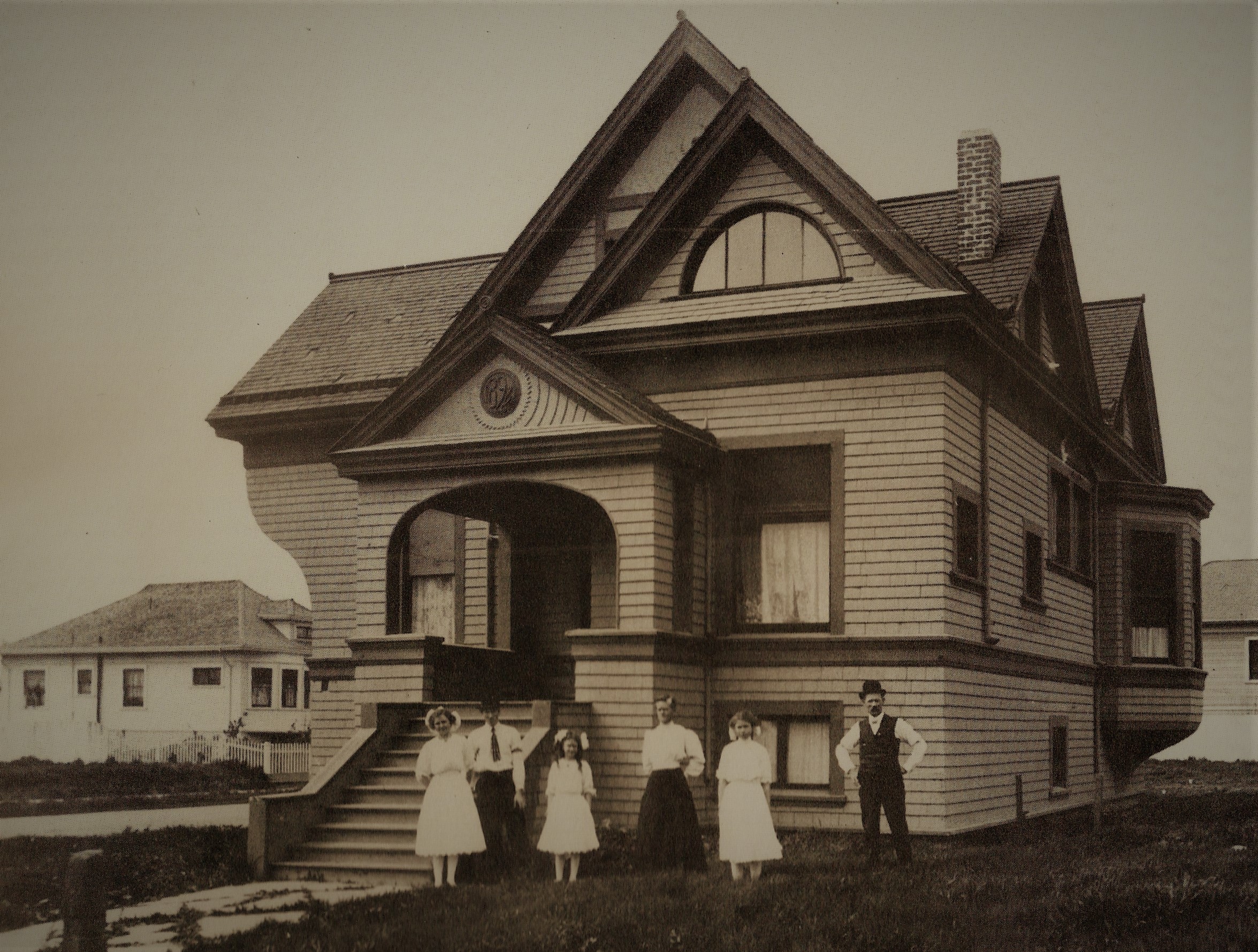
Though born in Chicago, John was raised in Seymour and had been an active Connecticut resident most of his life. A child of immigrants, most probably from Ireland, he was the second child and first son of Andrew and Mary Welch.
Both he and his wife had close family in the area, she had sisters, he had a brother, two sisters and a mother within a few miles.
His courtship of Cornelia “Nellie” Schatz had not been smooth. The daughter of a successful storekeeper and butcher, she and her sisters worked hard but lived a relatively stylish life that included driving their own ponies and carts and learning to play the piano and organ. John was an unsuccessful inventor and a struggling farmer, something of a dreamer. His niece wrote of him that he was “nice but poor.”
Family stories from both sides of the coast make it clear that Cornelia, also known as Aunt Conky, was sought after. One suiter was a very successful–if rather large–town son who graduated from Harvard and went on to be a wealthy beer brewer. In the end, however, it was John who won Cornelia’s heart. He was a slight but handsome, dapper man who paid meticulous attention to his appearance and his wife’s family admitted he could be very charming. Cornelia herself said that the ladies liked him. He was also prepared to wait as long it would take.
Part of Cornelia’s problem was a promise she made to her father on his deathbed in December of 1881. Family lore said he died ‘of the palsy’ at the age of 46. He seemed to have anticipated his early death and written his will earlier that year. Cornelia agreed to look after her mother and not to marry while Karoline Schatz was still alive. Her older sister, Barbara, married Charles Kronske in 1883 and left home. But there was still her little sister, nine year old Mary (Mamie), to help raise. Cornelia worked nearly eleven years to help her mother keep the family business going. Though she was not tall, she was strong and could easily lift the sacks of seed and other supplies the story carried. Still, the value of the estate decreased several thousand dollars by the time her mother passed away.
As luck would have it, depending on your perspective, Karoline died of a stroke in 1892 when Cornelia was in her late twenties. She had complained of a headache, collapsed on the way upstairs to her room and died in her daughter’s arms. She left no will but her daughters shared the estate three ways. The store and property were sold, including some parcels in Orange to a nephew, Eugene Schatz and to her son-in-law Adolph Brose. The estate was worth approximately $5500 which is the equivalent of $200,000 in 2025 dollars.
One year later, Cornelia tied the knot with John at St. John’s Rectory (Episcopalian) in nearby Bridgeport. They used some of her inheritance to buy a farm on Rimmon Hill, at the border of Beacon Falls. They lived there with their three children, Clarence (1894), Mabel (1896), Ruth (1899) and a farmhand who boarded, 60 year old John Beach.
They seemed to have lived a busy, involved life. In Seymour, John and Cornelia enjoyed the respect of the community and spent a lot of time socializing. There were family visits, church activities and John was active on the school board. But farming wasn’t their thing. They had several disasters including cold weather that killed off the chickens and a fire that burned the second story of their home, set off by their border smoking in bed. So, they sold the farm, moved Bridgeport and opened a candy store. Their last child, Dortha, was born in 1901. I doubt they took John Beach with them, in either case, he died in 1902.
 Apparently, the candy store did not work out. In 1903, these two very East coast citizens decided to move away from everything and everyone they knew and go to California. After a long crowded visit with the Broses, where Cornelia and the kids had stayed while John was out west, they packed up the kids and took the train across the country. Ruth Welch Veal said that it was because John Bernard had developed a bad cold that wouldn’t go away and the doctor recommended a warmer climate. It may have also been related to the fact that Cornelia’s family had experienced a rift over the inheritance left by John and Caroline Schatz to their three daughters. One branch (Barbara Kronski’s) had wanted the family business kept, but the other two forced a sale. Cornelia appears to have stayed in touch with both sisters, but Pauline Brose wrote that the rift between the Kronskis and the Broses never healed. Also, both Cornelia and her sister Mamie (Mary Brose) had given a significant sum of money to be invested by Mary’s husband. The venture tanked and may have left John Bernard broke and even more anxious for a new start in a new place.

 Welches In Berkeley