
The oldest family lore about John Bernard Welch’s parents, Caroline (Bridget) and Andrew Welch, is that they lived in a home that was destroyed by the Great Chicago Fire. Very dramatic story–except research shows that while their house may have burned down, by 1871, they didn’t actually live in it anymore. That’s usually how these stories go!
The Chicago years offer the first documented records of the couple. Proof that they were there come from Andrew’s war records, their granddaughter Ruth Welch Veal’s family history, and almost all the US census takers who note that their son John Bernard was born in Illinois. The rest of Andrew and Bridget’s children were born in New Haven County in Connecticut. Apparently the couple married and started their family in New Haven county, spent time in Chicago where their son was born April 20, 1861, then returned forever to Seymour, Connecticut.
There were five children born between 1858 and 1868: Margaret, John, Joseph, Michael and Anne. Also living with the young family was Andrew’s mother Mary Welch. There may be some pictures of them in the three family albums sent to Dortha Welch Ipsen from the 27 Grand Street, Seymour family home, but since they neglected to label anything, who knows?
It is possible that Bridget and Andrew met and married in Ireland. There is no immigration date for Andrew but two census reports record Bridget as arriving in the early 1850s. Whatever happened, they both end up in Seymour with at least their moms. Andrew may have farmed a bit, because he worked a farm in Chicago. However, the census records show he worked at a local copper mill, as did many men in Seymour, Connecticut.
Andrew’s mother was named Mary and a bit of a mystery. The only census record located so far is from 1870. This shows she was living with her son, and they were both born in Ireland. It doesn’t say if she was widowed, but that’s probably a safe assumption. Also, she was very likely Catholic given her burial in a Catholic cemetery! Veal’s account says she was from Wales. More on this later.
There is a funny story about Mary Welch’s age. The US 1870 census says she was born in 1790, which would have meant she was 90 when she died, not bad at all. Her tombstone in St. Mary’s Catholic Cemetery, claims she died at 109. The 109 claim to fame was repeated in Veal’s account even though a little math would show that if Mary had been born in 1770, then her son Andrew was born when she was 52! The story had legs however, and an article, “Anecdotes of People Who Have Lived a Century or a Little Less,” published in the Winterset Madisonian and Rock City Advertiser, Winterset, Iowa, 8 Dec. 1880, mentions her: Mary Welch, of Seymour, Conn., was the last of fourteen sisters; she was 107 (sic) years of age when she died a short time ago. This centenarian died of old age rather than any physical ailment.
Based on Veal’s family tree, Mary had at least three sons. Andrew, his brother Michael and a third, first name unknown. The family may have once have been Walsh, not Welch, because her son Michael used Walsh and and Andrew’s son Joseph changed his from Welch to Walsh years later.
The 1870 US census also shows that Andrew’s wife Bridget Hart was from Ireland. The muddled maps of Ansonia, Derby, Seymour, Bridgeport, New Haven, Beacon Falls and other towns make it a challenge to track families even when they only live a few miles apart, but there are other Harts, Walshes and Welches in the area. Whether they are relatives is yet to be proven.
Even though Bridget’s mother Margaret is ALSO buried with Andrew, Bridget and Mary Welch, she did not live with the Welch family in 1870 or 1880, so, who did she live with? As she was too old to housekeep, its another sign that perhaps there was family in the area.
Usually, Andrew reported himself as Irish, but on at least one occasion the census taker recorded that he was from Wales. His granddaughter Ruth wrote in the family notes that he and his wife came from Yorkshire, England. South Yorkshire is Wales. Andrew, that’s a definite maybe. But, it is less likely that Bridget was from Wales because she is always listed as Irish in the censuses. Further, in the 1910 US census she is living with her son-in-law who is definitely from Wales and she still tells the census taker she is from Ireland. In that same census/household, her daughter Annie shows both father and mother as coming from Ireland. Frankly, the references to a Welsh background don’t really begin until the next generation starts talking to the census takers! It is interesting to note that their son John Bernard always spoke with a soft voice and an Irish brogue, though he was born in the United States. Maybe his whole family did, however his children did not.
In the end, Andrew was American! He embraced his new country and in 1863, Civil War Draft records from Chicago show that he ‘claimed allegiance.’ Though he was married and a father of three small children, in 1865 he would spend a year in the Union army until the war ended and his unit disbanded. Although his wife was off raising babies in Seymour, I assume Andrew served with the Illinois division versus Connecticut because Chicago was where he was at the time he registered. Sergeant Andrew Welch with the Illinois Infantry 147 was discharged on January 20, 1866.
 Veal’s history says that Andrew was injured during his service but gives no other detail. He worked at the local copper mill both pre and post war and with his family lived in a home valued at $1500 per the US census of 1870. The census does not provide the address and, oddly, it’s listed under Bridget’s name. One possibility is that the house was gifted from her side of the family. Andrew died in 1873, at age 46, leaving behind a wife and five children and was buried in Saint Mary’s Catholic cemetery in Ansonia, not far from Seymour, the first in the plot so to speak.
Veal’s narrative says that John Bernard became the man of the family and took care of his widowed mother and siblings. He became a skilled carpenter and built his mother a very nice home complete with a well. The house came with a mortgage that would eventually be paid off using some of his wife’s Cornelia’s inheritance from her mom. However, realtor records show that house was built in 1870 when John Bernard was only nine and three years before Andrew’s death. Again, the 1870 census shows the family’s house already belonged to Bridget. So this story is a little off.
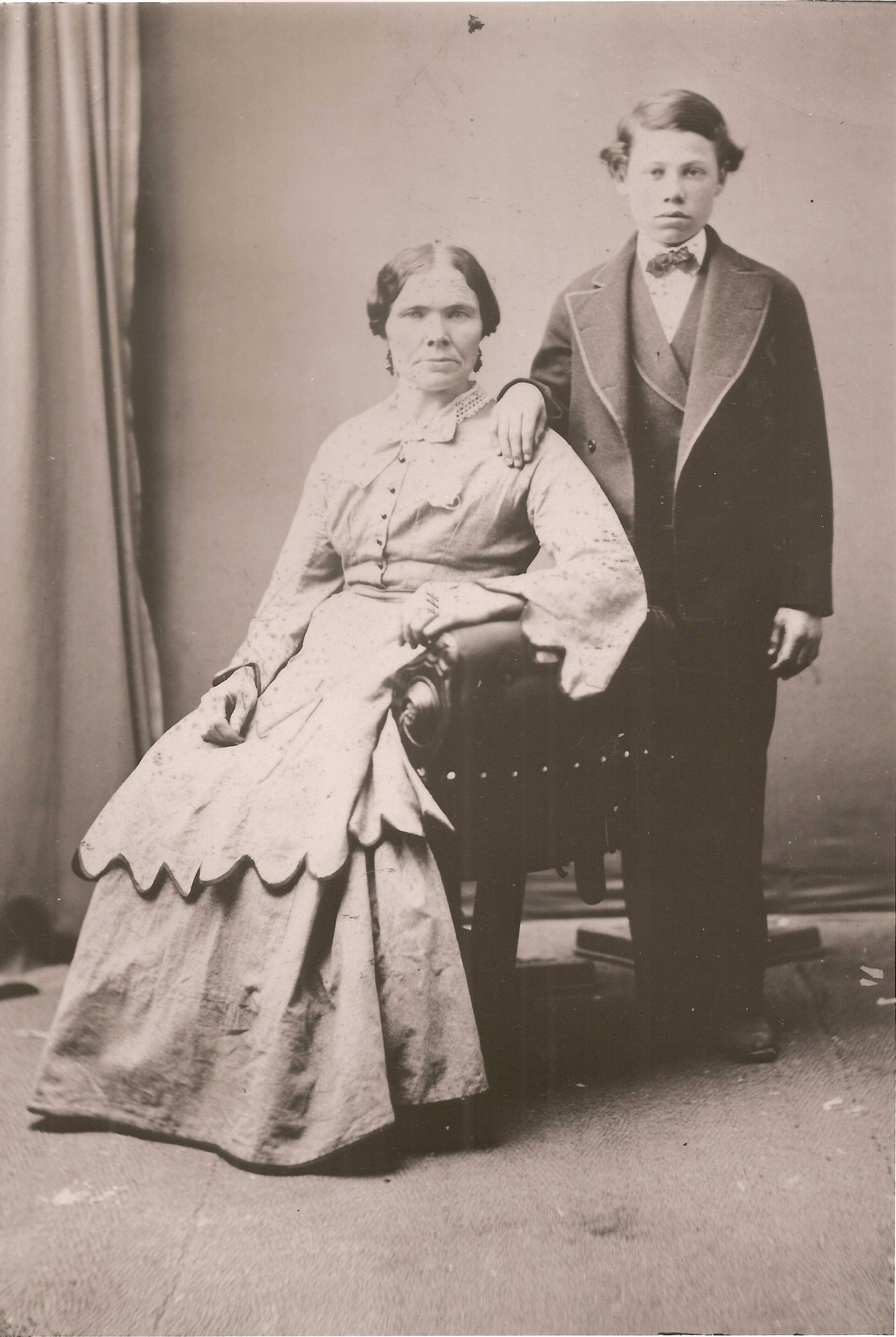
It is certain that after her husband’s death, Bridget kept house and company with her mother-in-law, until Mary died in 1880. Neither lady could read or write English. Her children attended at least some public school. John’s census records say the he could read, write and speak English but had no formal education but he did attend school as a child. Funny story about the picture above of John Bernard and his mother Bridget. He is sulking because even though she bought him his first long pants for the event, she wouldn’t let him cut his hair. At this point, we have an address for the house, which is on Grand Street and was still standing in 2025.
By 1880, all of Bridget’s children had joined the workforce except Annie. John was listed only as a laborer, but Joseph and Michael worked at an auger shop, augers being some sort of machine part. Margaret (Maggie) worked at the rubber mill.
 There is no record to show that John Bernard ever left the home until his marriage with Cornelia Schatz in 1893. He did leave the Catholic Church at some point and family lore was that the reason was he resented the church for taking his mother’s money when she was a struggling widow.
When John Bernard was 26, his older sister Margaret married and left home. That same year, 1888, his younger brother Michael died at age 22 from typhoid fever. He had been living in Bedford, MA, employed as a polisher. His body was sent home to be buried in Ansonia, but it’s unclear what happened next. He should have gone into cemetery with his father but he’s not listed there. Sometimes, however, if there is no money, graves go unmarked. Or, sometimes with typhoid and other contagious disease, corpses are buried separately.
Just one year later, John Bernard’s brother Joseph got married. He was a machinist and rented a home in Bridgeport where he would live with his wife for several years. Joseph changed his name to Walsh which adds to the mystery. Why change it? Welch is the English ethnic name for someone of Welsh origin; the usual form in Ireland is Walsh and in Scotland Welsh. Due to the onslaught of Irish immigrants after the famine, there was some anti-Irish sentiment. Did Andrew Walsh change his surname and Michael actually restored it?
This left the youngest, Annie. That good girl stayed with her mother. When she married in 1899, she did NOT leave, she brought her husband home. David Henry, who really did come from Wales, became the owner of Bridget’s house. This home will stay in the family for more than 100 years until the Henry family dies out and there’s no one around to inherit. Annie or David owned the three albums chock full of New Haven faces from about 1875 to 1920, most of whom can not be identified as family (yes, this source of irritation will come up often on this blog).

 Welches In Berkeley