Things were not going well but with his decision to move to Berkeley, California, John Bernard Welch, doting husband and father of four, hoped to change that.
A few years before, he and his wife Cornelia Schatz Welch had left family and friends in Seymour, Connecticut to make the trip west for a new life on a farm bought sight unseen. His wife’s family had reservations, John was a dreamer; charming but undependable and he had an unimpressive track record when it came to business. More key, he was using his savings, including the last of his wife’s inheritance, to finance the new adventure. He had gone out ahead of his family to scout out opportunities, ‘in the Shasta mountains.’ He ended up how purchasing a farm in Stockton, California, sight unseen.
The Schatz family fears about John’s business acumen were justified, the land purchased in Stockton was unusable. It was a bitter disappointment, leaving the family financially strapped. John was a carpenter but work was hard to find. He chased it though. He tried, unscussessfully, to open another candy store. After leaving Stockton, he worked for a lumber company. There were a couple more years in Black Diamond, about 120 miles away and now known as Pittsburgh, California. It was hard and, at times, Cornelia took in wash to help make ends meet. Eventually, the family settled in Berkeley, hoping to cash in on post earthquake work in construction. Now 44, John joined the United Brotherhood of Carpenters and Joiners of America union #1689. A strong union man, he was also a registered Republican.
The earliest address found for the family was at 113 Sixth street but it was apparently a short stay. By 1908 their second home at 1814 Sixth Street in Berkeley, was a couple blocks down and must have been bursting at the seams with two adults, two teenagers and two grade school children. It was only 704 sq ft, a one bedroom built in 1900. They stayed there a couple years from 1908 thru 1910. There is a third address, number 1917 on the same street, where the family lived in 1911 and then, listed on one of Clarence’s textbooks, a final 6th street address just doors down at 1912.

That opens the possibility that John worked on houses for a local contractor and his family lived in them until they were finished, before moving into the next. This was a common arrangement. Staying in the area also meant that his four children could attend San Pablo Elementary, where Clarence would finish his school career by either 6th or 8th grade. His sisters would later say that he never went to high school because he helped his family earn money. Unfortunately, John was often out of work and needed other ways to earn money. He put time in at a local refinery, he was a night time security guard and he even travelled far North to work on the Great Highway project in Alaska. at different points during these years.
That said, the first house that everyone thought of as home was on Channing Way and still stands today (2025).
On a 5000 sq ft lot, at that time without buildings around it, the house was about six years old and architecturally significant for the times. Built around 1892, it was not a traditional Victorian, but more whimsical. An identical home was built next to it. Very roomy for a home of the times at 1,941 sq ft. Dortha described it for a local newspaper 66 years later:
“At that time the house was considered novel. It had 8 rooms, a butler’s pantry, a sun porch, one and a half baths and two unfinished rooms in the basement with a laundry chute from the second floor. Between the living room, dining room and library were sliding doors and the walls were of red plush cloth. Each room had an intercom connected to the kitchen and the house was supplied with both a gas line and complete electrical wiring ready to be hooked up when the city’s electrical lines were installed.”
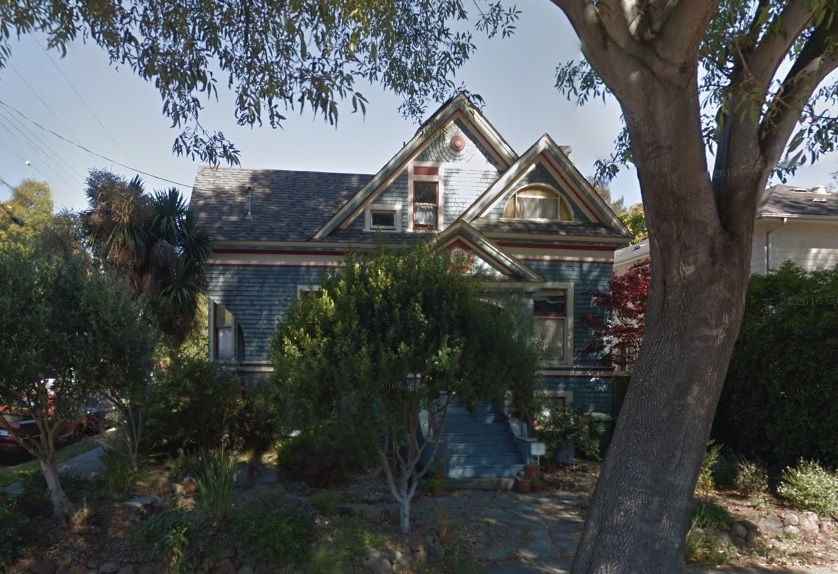
In 1915, Clarence met and married Estella Youngberg, and they remained in the house while the rest of the family moved to a home on Bancroft, across from the University. The streets were changed and that house no longer exists, but it was just a few short blocks from the City Hall. During that time, Phil Horan, the son of John’s sister, Margaret, came to stay. He applied for work at the local shipyard and registered, as required, for service during the first world war. Unfortunately, he has serious issues vaguely referred to by his cousin Dortha that included emotional outbursts and trashed rooms. When John returned home, Phil was sent back East immediately.
The girls attended Berkeley High, with both Ruth and Mabel graduating. All appeared to have spent a little time at business school and joined the workforce soon after. Mabel and Dortha would quickly find work with the city government, jobs they kept for their entire careers. Even Ruth, after working for years for a lawyer, finished as a Deputy Clerk for the area.

 Welches In Berkeley